











Thanksgiving is a time for gathering, giving thanks, and remembering that joy is possible even when life has been hard. Few films capture that spirit better than Mission: JOY.
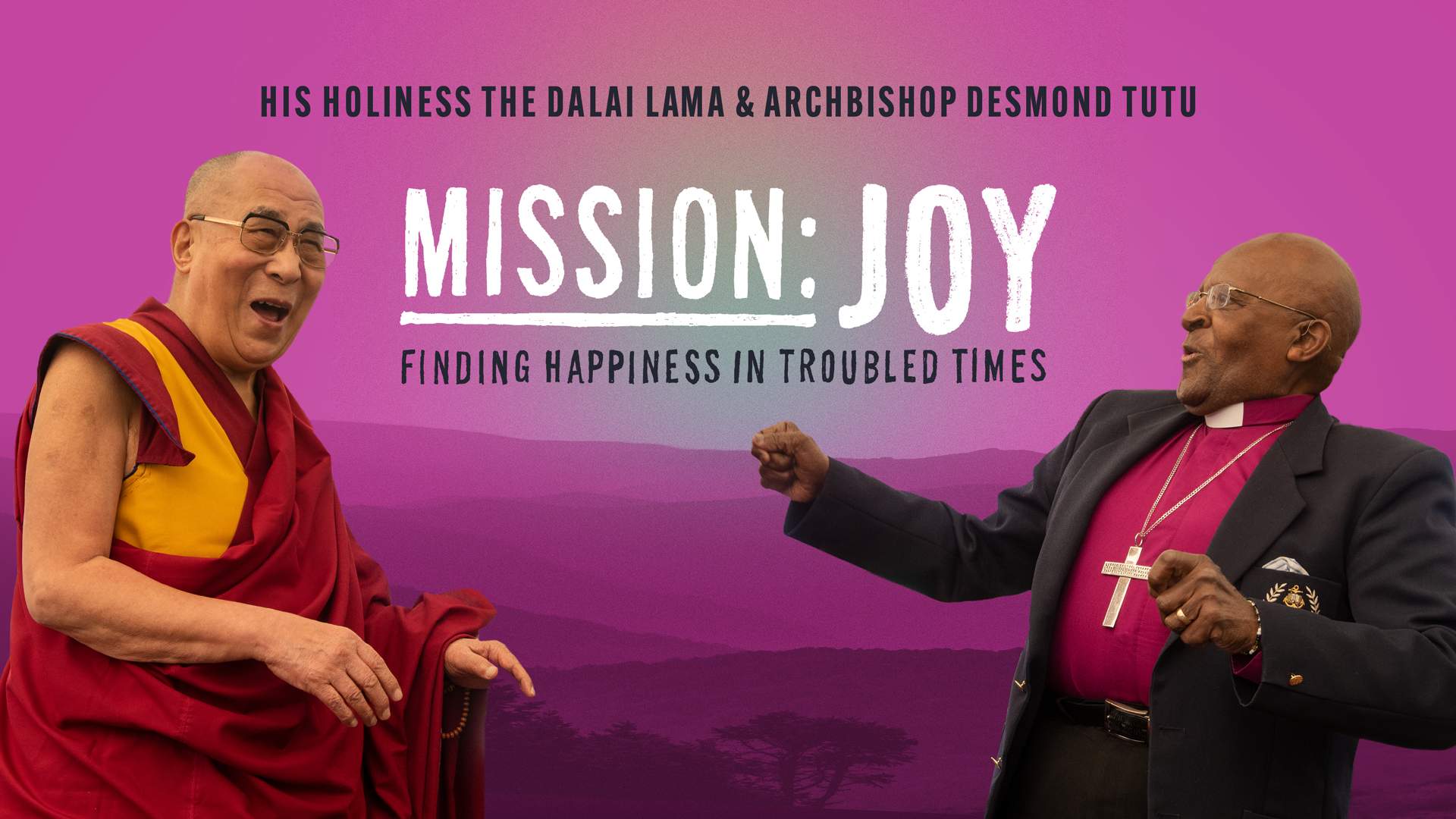
The documentary captures the unlikely, laughter-filled friendship between His Holiness the Dalai Lama and the late Archbishop Desmond Tutu, two Nobel Peace Prize laureates whose lives were defined by profound adversity – decades of exile for the Dalai Lama and the Archbishop’s long struggle with the violence and injustice of apartheid.
The two beloved figures sat together for five days in Dharamsala, India and mostly just cracked each other up. The result is the 90-minute documentary and the massive citizen-science project it inspired.
The film shows how their shared resilience, humor, and deep wisdom offer a practical path for anyone seeking to hold onto hope and agency when the world feels overwhelming. “People are always yearning to see deep connections. To see deep wisdom and to learn,” co-director and producer Peggy Callahan said. “And who doesn’t love to laugh through all of that at the same time?”
Despite extreme hardship, loss, and the weight of leading their people through some of the darkest chapters of the twentieth century, both men emerged as living proof that joy is not the absence of suffering but an inside job that can be cultivated even in the most troubled times.
Happiness During Hardship
The film’s central premise is that their joy was not naïve or accidental. As Callahan put it, “Joy is an inside job. No one can really take your joy. You can give it away. But it is an inside thing. You get to build that yourself.”
Callahan said watching the two Nobel Peace Prize laureates together reinforced what she had already concluded in her twenties: “The most interesting people have gotten their ass kicked at some point… they’ve gone through such traumatic times and through it all they found joy.”
The Dalai Lama and the late Archbishop Desmond Tutu spent as much time teasing one another, as they did discussing what they endured, with both men finding every opportunity to make each other smile.
“They were like little kids,” Callahan recalled, remembering a lunch when the cameras weren’t rolling when she had to remind the two icons to eat between laughs.
In one of the film’s most memorable scenes, Callahan brought trick relighting birthday candles to a celebration of the Dalai Lama’s birthday. The candles had a practical purpose for a windy outdoor shoot, but she also knew the mischievous brothers would be amused. The result was pure delight captured on camera, as Tutu quickly became aware of the joke.
The documentary pairs deep lived wisdom with research. Callahan insisted on including science because she wanted the film to show that the spiritual insights and the data support one another. Viewers see moments of genuine laughter and connection, then hear researchers explain why certain simple actions, such as shifting perspective, expressing gratitude, or celebrating someone else’s joy reliably improve well-being.
By weaving the two together, the film makes the case that joy is not only a profound inner practice but also something that can be understood, measured, and deliberately strengthened, no matter what circumstances a person is facing.
Putting the Film’s Teachings Into Action
When it came time to promote and distribute the film, Callahan naturally turned to social media and initially considered challenging people to complete their own Acts of Joy. Out of that grew The BIG JOY Project, a free seven-day experience that teaches participants how to create more joy in their lives. It was co-created with scientists at the Greater Good Science Center at UC Berkeley, UC San Francisco, and Harvard, and it is not the world’s largest-ever citizen science project on joy.
120,085 participants from 221 countries and territories have already completed more than 490,000 Acts of Joy.
Participants spend roughly seven minutes a day for seven days trying one tiny Act of Joy—things like celebrating someone else’s good news, shifting perspective on a frustration, or sharing a laugh. At the end they receive a personalized report showing which acts worked best for them.
The early results have been striking with participants reporting:
- 25.59% increase in peace of mind, well-being
- 12% improvement in sleep
- 23% increase in ability to have positive emotions
- 27% increase in feeling agency over joy in their lives
- 30% more content with friendships & relationships
- 34% increase in feeling in control, coping well
The study is ongoing and you can still take part here.
Reaching People Who Need It Most
Getting Mission Joy out into the world was never straight forward. Geopolitical complications around one of the protagonists slowed conventional deals. Instead of waiting, the team created free pathways: more than 1,400 community screenings reaching over half a million people, broadcasts on networks such as the BBC and CBC, access for 40,000 incarcerated learners in U.S. prisons, and a single Facebook global watch party that drew 13.3 million views.
The film is now available in 244 countries and territories through a mix of streaming platforms, with carve-outs that have always prioritized free or low-barrier access for schools, faith communities, and underserved audiences. Proceeds from paid views help underwrite those free screenings.
Why Now More Than Ever Is Time to Watch
The documentary premiered in 2021 and Callahan doesn’t claim there is a uniquely perfect moment to watch. “I don’t think there’s ever a bad time to learn from wise people and laugh while you’re learning,” she said.
However, she observed that many people feel the weight of the news cycle and are looking for tools that restore a sense of agency. Once you have seen two men who endured so much still find reasons to joke and to look out for each other, it becomes harder to treat joy as something that only arrives when circumstances improve.
Thanksgiving has a way of gathering people who don’t always see the world the same way around the same table. Mission: JOY feels made for exactly those moments, showcasing two men from very different spiritual traditions who nonetheless found common ground in the things that matter most: love, empathy, resilience, and the choice to keep choosing joy.
For current viewing options by country, visit: missionjoy.org/watch-the-film.
To try the Acts of Joy yourself, visit: missionjoy.org/bigjoy