








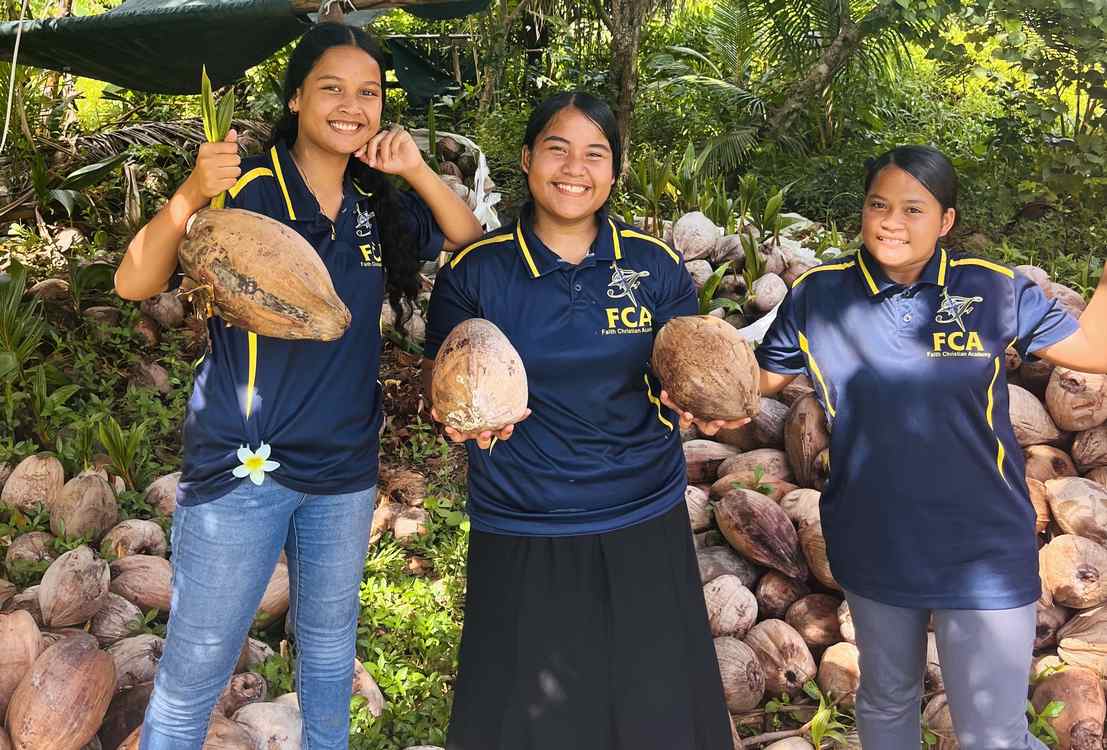
The coconut palm is often called the Tree of 1,000 Uses, though ‘school tuition voucher’ is not typically one of those 1,000.
Yet the Faith Christian Academy in Micronesia is, in fact, accepting coconuts in lieu of tuition costs—to help ease the financial burden on families while making use of the ubiquitous fruits that pile up all around.
The Academy’s new tuition plan actually clears 2 hurdles in 1 leap. Students can easily afford tuition while sparing themselves the dangers and toil of fishing to make money. On the other, the coconuts are used by the Academy to rebuild Yap Island’s once-flourishing coconut oil industry.
“Yap is beautiful, but cash is hard to come by,” says Paul Zimmer, founder and CEO of 3 different organizations working on Yap Island, including the Academy. “Almost every family lives off the land and sea. 95% of households grow crops, 88% fish, and 78% grow coconuts, nearly all for their own table.”
“We asked a simple question: what if the thing Yap has in abundance could help pay for the thing families want most for their kids?”
Zimmer would go on to tell GNN that only one-third of all islanders had cash-paying work, most of which was through the government. The notion of a local economy is almost a dream. Everything needed that can’t be grown is imported, and virtually nothing is exported. That wasn’t always the case, however.
According to Zimmer, this island state within the Federated States of Micronesia used to be a large exporter of virgin coconut oil, but slowing exports through the ’90s stopped entirely by the mid-2000s “because prices were low, shipping was poor, and the palms were aging.”
Though the market was gone, the coconuts kept on growing. At the same time, a decade of balancing the books at Faith Christian Academy (FCA) demonstrated that students would often have to work themselves to the bone to afford the tuition costs.
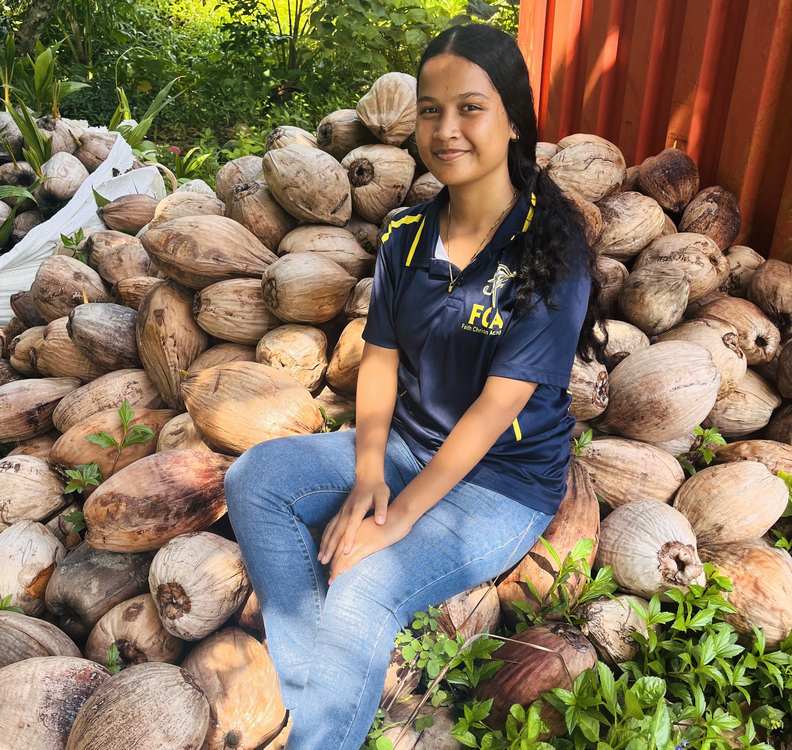
At times, this would involve dangerous nighttime fishing, while at other times it meant double shifts at work for low-wage earners: like the father of Shayalynn, whose family is from the outer island of Ifaluk, but who has attended FCA since 2017.
“I felt relieved and happy about it because my dad didn’t have to work a lot for my tuition,” she said, remembering when she first heard about the coconuts, “The first year that I started in FCA in 2017, he had to work double shifts just to be able to pay for my tuition, the food on the table, and the clothes that I had to wear to school.”
FROM THE PACIFIC: Archaeologists Uncover Ancient City in Kingdom of Tonga That Rewrites History: ‘First City of the Pacific’
“[Now] he doesn’t have to work too much. He can stay at home and I can see him often. He can spend time with our family and his kids.”
Zimmer shares another example: of a young man planning to sacrifice his entire summer fishing, day and night, to afford school for himself and his younger siblings. The notion of picking up coconuts, or “copras,” as they’re called locally, changed everything.
“A kid who was ready to give up his summer for his siblings gets to be a kid again, and his family can pay for school with what grows right outside their door.”
ALSO CHECK OUT: Marshall Islands Experience Explosion of Wildlife One Year After Invasive Rats Were Removed
Utilized for food, water, oil, fuel, lashing and cordage, storage, and construction materials since the very dawn of the Pacific’s colonization, the coconut palm provides in a way that few other crops can. Perhaps as a result, FCA students told GNN that collecting them is kind of like a reward in itself.
Sophomore Joyleen, born and raised on Yap and one of 8 children, said that gathering coconuts reminds her of helping her dad when she was young, while a senior named Roy said collecting with friends and family is fun.
“My happiest moment is to go and collect coconuts, not only by myself but with friends and cousins,” said a junior named Jucken, another outer islander.
In short, coconuts aren’t only money makers, but memory makers.
COCONUT CUTS: Teen Discovers Coconut Fungi Can Filter Plastic and Sunscreen From Sea—And Wins Science Fair
As far as making money, Zimmer’s Island VCO (Virgin Coconut Oil) is getting ready for its first shipments of high-grade oil, proven to contain less than 0.09% moisture for excellent shelf life. Pesticides are not allowed on Yap, so the coconuts are naturally organic—USDA certification for which Zimmer is currently pursuing.
“Every coconut is cold-pressed on the same day we receive it, so the oil is as fresh as it can be. Island VCO is registered with the FDA, and we are finishing label review so our first shipments can reach American shelves.”
“Down the road, we would like to open the program to the other private schools on Yap, then other islands in Micronesia and the Marshall Islands. Whatever is left after costs goes to meet the needs of the people through Pacific Helps, the nonprofit (also run by Zimmer).”
WATCH Zimmer tell the story below…
CRACK Open This Brilliant Good News Nut With Your Friends On Social Media…