













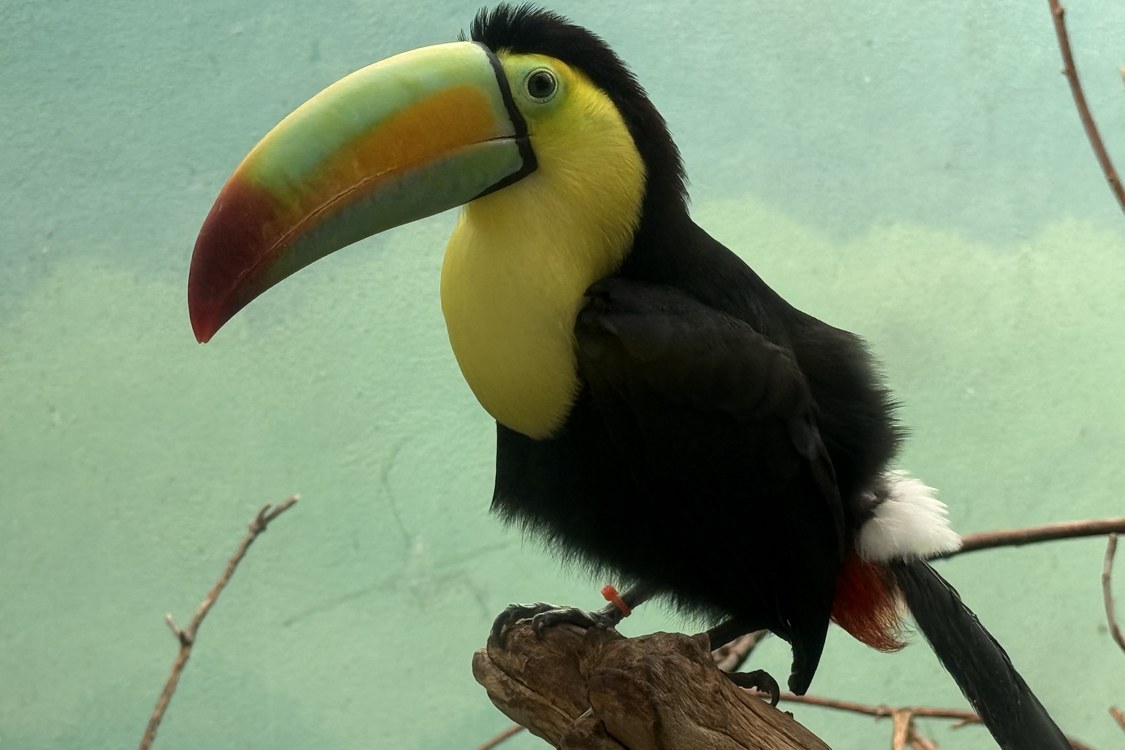
14 trafficked toucans rescued at the US-Mexico border now have a chance to contribute to conservation and the public’s awareness of wildlife crime following successful rehabilitation.
Agents from US Fish and Wildlife Service took ownership of the keel-billed toucans after they were seized at the the Otay Mesa port of entry in California.
They were assisted by members of the Wildlife Conservation Society’s (WCS) Bronx Zoo, who came to ensure the animals were properly cared for until a suitable decision could be made on their future.
Having been sedated, bound to restrict movement and noise, and hidden in the dashboard of a vehicle, they were in extremely poor condition upon rescue. Keel-billed toucans (Ramphastos sulfuratus) are protected by the Wild Bird Conservation Act, and the Convention on International Trade in Endangered Species (CITES).
Upon arrival at the Bronx Zoo on July 31st, 2025, all 14 toucans showed signs of malnutrition, severe stress, and metabolic issues. Through a coordinated effort between the Bronx Zoo’s Ornithology and Zoological Health Departments, the birds received specialized care and rehabilitation over several months.
“Thanks to the dedication of our animal care and veterinary teams, we were able to stabilize and rehabilitate them,” said Chuck Cerbini, Curator of Ornithology at the Wildlife Conservation Society’s Bronx Zoo.
10 of the toucans were transferred to Association of Zoos and Aquariums (AZA) accredited institutions where they will now contribute to conservation breeding and education programs. For multiple reasons, it is not possible to return birds that have been subject to these conditions to the wild.
4 of the rehabilitated toucans, two of which have recovered from fractured legs due to the effects of malnutrition, will remain at the Bronx Zoo. Two of these birds, both males, can be visited in the World of Birds. The other two are off-exhibit and are a future breeding pair.
Keel-billed toucans, native to tropical forests of Mexico, Central America and parts of South America, are listed by IUCN as Near-Threatened through a variety of factors, including capture for the pet trade and deforestation. The species is listed on CITES Appendix II, meaning its trade is strictly regulated.
FROM THE BRINK: Bald Ibis ‘the Herald of Spring’ Saved from Extinction in Turkey Thanks to Semi-Wild Breeding
In addition to these rehabilitation efforts, WCS is working across the toucan’s range to protect nature strongholds in Mexico, Central America, and South America, and to stop wildlife poaching at the source.
“The work of the Wildlife Conservation Society’s Bronx Zoo to rehabilitate these toucans is a testament to the skill and dedication of their veterinary and animal care teams,” said Sara Walker, Senior Advisor on Wildlife Trafficking at the Association of Zoos and Aquariums.
CLEAN BILLS OF HEALTH: After Soccer Ball Slams into Seagull, Watch a Player Use CPR to Gently Revive it (WATCH)
“The Association of Zoos and Aquariums’ Wildlife Confiscations Network supports law enforcement at the point of confiscation, helps guide animals through recovery, and coordinates placement across vetted facilities when they cannot be returned to the wild. Over the past three years, the Network has helped place more than 4,000 animals.
“While not every case has a happy outcome like this, we’re thrilled to see these toucans healthy and now placed across seven AZA-accredited institutions—reflecting the coordination across a broader network of partners.”
SHARE This Great Teamwork By Law Enforcement And Zoo Staff…